Imposter Syndrome Reset: 2-Minute Interrupt + Checklist

Why Imposter Syndrome Feels So Convincing (Even When You’re Doing Well)
Imposter syndrome can feel like carrying a private fear that success is accidental—and that being “found out” is only a matter of time. It shows up in high achievers, beginners, career changers, and anyone stepping into new levels of visibility or responsibility. The most effective way to reduce it is to treat it as a pattern of thoughts, behaviors, and avoidance, then replace that pattern with repeatable skills: naming the trigger, gathering evidence, taking calibrated action, and building support.
The experience is widely recognized as the “impostor phenomenon,” a common pattern rather than a personal defect or lack of talent (see the American Psychological Association definition and the foundational work by Clance & Imes (1978)). It can also be influenced by culture and context—Harvard Business Review has noted how over-focusing on “fixing” individuals can overlook workplace dynamics (see Harvard Business Review).
What Imposter Syndrome Looks Like in Daily Life
- Discounting wins: success gets attributed to luck, timing, or “easy” tasks, while mistakes get credited to personal flaws.
- Moving goalposts: achievement brings brief relief, followed by a new standard that must be met to feel “legitimate.”
- Overpreparing or procrastinating: either working excessively to avoid criticism or delaying to avoid evaluation.
- Fear of visibility: avoiding presentations, publishing, applying, or asking for promotions despite readiness.
- Comparing “inside to outside”: judging personal doubts against other people’s highlight reels.
Common Triggers for Professionals, Creatives, and Students
- New roles and higher stakes: promotions, internships, first clients, new academic programs, or leadership responsibilities.
- Ambiguous feedback: unclear expectations, inconsistent grading, or subjective creative critique.
- Identity and belonging pressure: being underrepresented in a field, returning after a break, or switching careers.
- Perfectionism norms: environments that reward flawlessness over learning and iteration.
- Public evaluation: portfolios, auditions, peer review, performance reviews, social media, and competitive cohorts.
A Fast Reset: The 2-Minute Imposter Interrupt
When the feeling hits, the goal isn’t to “think positively.” It’s to interrupt the spiral and choose a next action small enough to complete.
- Name the moment: “This is imposter syndrome showing up, not a fact about ability.”
- Locate the trigger: identify the event (feedback, deadline, comparison, high visibility) that activated the feeling.
- Switch to evidence: list 3 concrete proof points (results, grades, shipped work, testimonials, solved problems).
- Choose the next smallest brave step: one action that moves work forward in 10–20 minutes (draft, outline, send, practice).
- Set a time box: commit to a short sprint to reduce emotional load and build momentum.
Actionable Checklist: Replace Doubt with Repeatable Behaviors
- Create an “evidence file” (a note, folder, or doc) for wins, feedback, and outcomes; review weekly.
- Rewrite the story: convert global judgments (“I’m not good enough”) into specific, solvable gaps (“I need practice with X”).
- Use calibrated standards: define what “good enough for this stage” means before starting.
- Build a feedback loop: request targeted feedback (one question) instead of broad validation.
- Practice exposure: schedule small visibility reps (share a draft, ask one question, present to one person).
- Reduce isolation: choose one support person (mentor, peer, coach, counselor) and set a recurring check-in.
Imposter-to-Action Checklist (pick 1 from each column)
| When it hits | What to do in 10 minutes | What to schedule this week | What to track |
|---|---|---|---|
| Before submitting or publishing | Draft a “Version 1” and send to a trusted reviewer | One low-stakes share (small group, private link) | Time spent vs. outcome (did overwork help?) |
| After critical feedback | Extract 1 actionable improvement and 1 strength from the feedback | One practice rep focused on the improvement | Number of reps completed |
| When comparing to others | Write 3 differences in context (time, resources, experience) + 1 lesson to adopt | A 30-minute learning block on the lesson | Skills gained (notes, examples, mini-output) |
| When avoiding a big task | Open a blank doc and write the first ugly paragraph or first bullet list | Two 25-minute sprints on the task | Started/finished dates (reduce “never started”) |
| When feeling “found out” | List 3 proof points from the evidence file | Ask for expectations: “What does success look like here?” | Clarity gained (new criteria, next steps) |
Practical Scripts for Real Situations
Targeted Strategies by Role
When It May Be More Than Imposter Syndrome
Put the Checklist Into a Weekly Routine
Recommended Digital Guides (In Stock)
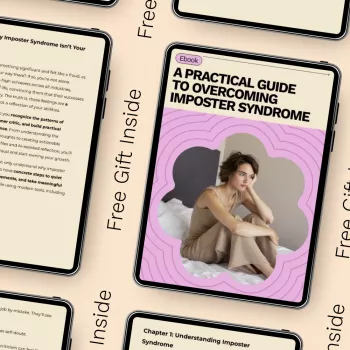
- A Practical Guide to Overcoming Imposter Syndrome – Actionable Checklist for Professionals, Creatives & Students | Learn How to Overcome Imposter Syndrome with Confidence
- Odor-Free Shoes Checklist | Easy Guide on How to Remove Odor from Shoes Naturally | Printable Shoe Care Checklist
- The Real Cost of Pet Adoption | Ebook Guide – Pet Adoption Costs Explained for New & Future Pet Parents
FAQ
Is imposter syndrome a mental illness?
No. It’s commonly described as a pattern of thoughts and behaviors (the “impostor phenomenon”), not a formal diagnosis; however, persistent distress can overlap with anxiety or depression, and professional support can be helpful if symptoms worsen or interfere with daily functioning.
Why does imposter syndrome get worse after success?
Success often raises visibility and stakes, which can trigger “moving goalposts” and fear of maintaining performance. Using evidence, setting calibrated standards, and planning the next smallest brave step can keep wins from turning into pressure.
What is one small thing to do today to feel more confident?
Take 10 minutes to write 3 concrete proof points, define the next smallest brave step, and complete one short sprint. Save the result (and any positive feedback) in an evidence file so confidence can be rebuilt from real data.











Leave a comment